Key points
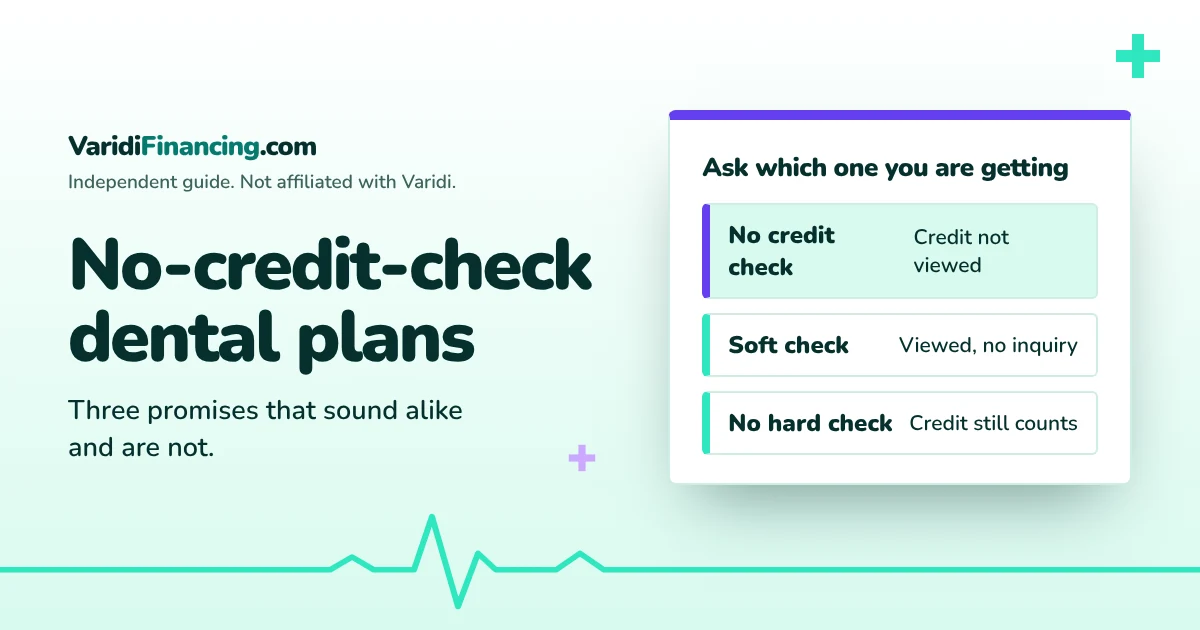
- “No credit check” and “no hard credit check” are different promises. Ask which one you are getting.
- Truly no-check plans usually charge a deposit or a one-time fee in place of interest.
- Always convert the cost to dollars and compare it with at least one alternative.
A cracked molar does not check your credit score before it starts hurting. Dental bills are also one of the main ways Americans end up in health care debt. In KFF’s survey, 41% of adults had debt from medical or dental bills, and about half of those with debt said dental bills contributed. Six in ten of that group had dental coverage at the time.[1]
So a payment plan is often part of getting treatment done. If your credit is bruised, the phrase “no credit check” is appealing. Here is what it means in practice and what it tends to cost.

What “no credit check” really means
Dental offices use three different phrases, and they are easy to mix up:
- No credit check. Nobody looks at your credit report. Approval rests on something else, such as your income or your history with the practice. Varidi describes its plans this way and says it does not use credit scores, reports or bureaus.[2]
- Soft credit check. The provider views your credit without an inquiry that affects your score. Cherry says it uses only a soft check.[3] Your credit still decides approval and rate.
- No hard check to apply. You can see offers without a hard inquiry, but your credit profile matters and the account may be reported afterwards. Sunbit works this way and reports account activity to a major credit bureau.[4]
If you have been turned down for credit before, only the first kind removes the obstacle.
The three kinds of plan you will be offered
1. The office’s own in-house plan
The practice lets you pay in installments, often half upfront and the rest over a few months. There is usually no interest. The office is taking the risk itself, so it may limit plans to existing patients or smaller treatments.
2. A managed no-credit-check plan, such as Varidi
The office uses outside software to run the plan and collect payments. With Varidi you apply on your phone at the office, get an instant decision and repay in fixed monthly amounts with no interest.[5][6] You pay a one-time setup fee before treatment, typically 2% to 18% of the plan according to Varidi.[7] One research caveat: the main independent study of Varidi plans was done in veterinary clinics, where guaranteed plans carried a fee of 18% to 22%.[8] Dental fees may differ, so ask.
3. A point-of-sale loan with a soft check
Cherry and Sunbit are common in dental offices. Both list APRs from 0% to 35.99%. Cherry offers terms of 1 to 60 months and Sunbit 3 to 72 months.[3][4] Sunbit states that patients pay no late fees.[4] These are loans, your credit profile shapes the offer and a strong applicant may see a true 0% rate.
What it costs: a $1,500 crown over 12 months
Swipe the table sideways to see every column.
| Option | Upfront | Monthly | Extra cost |
|---|---|---|---|
| Varidi, 5% setup fee | $75.00 | $125.00 | $75.00 |
| Varidi, 18% setup fee | $270.00 | $125.00 | $270.00 |
| Loan at 0% APR | $0.00 | $125.00 | $0.00 |
| Loan at 19.99% APR | $0.00 | $138.94 | $167.33 |
| Loan at 35.99% APR | $0.00 | $150.69 | $308.23 |
Two things to notice. A no-interest plan with a high fee can cost about as much as a high-rate loan. And the fee is due before treatment, while loan interest is spread across the payments. If cash today is the problem, that timing matters as much as the total. See our setup fee breakdown for more.
Want a loan quote to compare against the plan your dentist offered?
Compare financing optionsWhat offices look at when they skip the credit check
Skipping the credit report does not mean anyone is approved for any amount. Something has to stand in for the score. In practice it is usually one of these:
- Your income against the payment. Varidi says eligibility rests on your ability to make the payments.[6] In the 2025 study of its plans, the monthly payment could not exceed 10% of the applicant’s self-reported income.[8] On that rule, someone reporting $2,500 a month could carry a payment of up to $250.
- Money down. A deposit or setup fee shows commitment and lowers what is left to collect.
- Your history with the practice. In-house plans go more easily to patients the office already knows.
- Automatic payments. Expect to put a debit or credit card on file. Varidi deducts payments automatically from the card you designate.[6]
If the payment you are offered is more than about a tenth of your monthly income, ask for a longer term or a smaller first phase of treatment. A plan you can keep is worth more than a plan you were approved for.
A worked example: choosing between two offers
Say your dentist quotes $1,500 for a crown and offers two ways to pay over 12 months. Option A is a no-credit-check plan with a 10% setup fee. Option B is a soft-check loan, and your offer comes back at 24.99% APR.
Option A costs $150.00 extra, all of it due today, with payments of $125.00. Option B costs about $210.71 extra, nothing due today, with payments of about $142.56. Option A is cheaper overall. Option B is easier this week and reports to the credit bureaus, which helps if you pay on time. Neither is wrong. The right one depends on whether your tighter constraint is cash today or total cost.
Seven questions to ask the dental office
- Is there any credit check at all, soft or hard?
- What do I pay today, in dollars?
- What is the monthly payment, and for how many months?
- Is there interest? Is any of it deferred?
- What happens if a payment is late or fails?
- Can I pay it off early without a charge?
- If treatment changes or is cancelled, what is refunded?
Red flags
- “0% interest” with a deadline. That can mean deferred interest. On a medical credit card such as CareCredit, an unpaid promotional balance triggers interest from the purchase date at 32.99% APR.[9] The CFPB found patients paid about $1 billion in deferred interest from 2018 to 2020.[10]
- Pressure to sign in the chair. You are entitled to read the terms first.
- A fee described only as a percentage. Ask for the dollar figure.
- Financing for more than the written estimate. Borrow for the treatment, not a round number.
Ways to shrink the bill before you finance it
Financing a smaller number is always cheaper. Ask whether the office has a membership or discount plan, whether there is a cash discount for paying part upfront and whether treatment can be phased across benefit years if you have insurance. Dental schools and community health centers often provide care at reduced fees, which is worth a call when the treatment is not urgent.
The bottom line
A no-credit-check dental payment plan is a legitimate way to get treatment when credit is the barrier. You pay for that access through a deposit or a fee, so the smart move is simple: get the cost in dollars, compare it with one alternative and choose the lower total you can reliably keep up with. Our Varidi review and comparison of alternatives can help you do that in a few minutes.
Frequently asked questions
Can I get dental work with bad credit and no money down?
Sometimes. Truly no-credit-check plans exist, but most ask for something upfront: a deposit on an in-house plan, or a setup fee on a plan like Varidi.[7] Ask the office what is due on day one.
Does a no-credit-check dental plan hurt my credit?
Applying should not, since no inquiry is made. Varidi says it does not check credit or report on-time payments.[7] Any unpaid debt that is sent to collections can still affect your credit, whatever the plan.
Are dental membership plans the same as payment plans?
No. A membership or discount plan lowers the price of care in exchange for an annual fee. It does not spread the cost over time. Some offices let you combine a membership discount with a payment plan.
What is the cheapest way to finance dental work?
A true 0% APR plan with no fee, if you qualify. After that, a low-fee no-interest plan or a low-rate personal loan. The most expensive outcomes usually involve deferred interest that was not cleared in time.
More guides
- Is Varidi really 0%? The setup fee, explained with real numbers
- Varidi vs. CareCredit: which is safer for a vet or dental bill?
- How to pay a vet bill you can’t afford: 8 options, ranked by cost and risk
- Varidi vs. Scratchpay: which vet payment plan costs less?
- Varidi requirements: who qualifies and what you need to apply
- Varidi vs. Cherry vs. Sunbit: which payment plan costs less?
- Missed a Varidi payment? What happens and what to do
- Varidi financing: the complete overview
Sources (10)
- KFF, “Health Care Debt in the U.S.: The Broad Consequences of Medical and Dental Bills” (June 2022). Accessed November 12, 2026.
- Varidi, “Services”. Accessed November 13, 2026.
- Cherry, “Does Cherry Charge Deferred Interest?”. Accessed November 13, 2026.
- Sunbit, “Dental Financing”. Accessed November 13, 2026.
- Varidi, “How It Works”. Accessed November 12, 2026.
- Varidi, “For Customers”. Accessed November 13, 2026.
- Varidi, “Individual Frequently Asked Questions”. Accessed November 13, 2026.
- Cammisa H.J., Hill S. (2025). “A prospective observational study of how veterinary clinics and their clients utilized a no-credit-check, third-party managed installment financing option to increase access to veterinary care.” Frontiers in Veterinary Science, vol. 12. Accessed November 13, 2026.
- NerdWallet, “CareCredit Rewards Mastercard Review” (June 17, 2026). Accessed November 12, 2026.
- Consumer Financial Protection Bureau, “CFPB Report Highlights Costly Credit Cards and Loans Pushed on Patients” (May 4, 2023). Accessed November 12, 2026.