At a glance
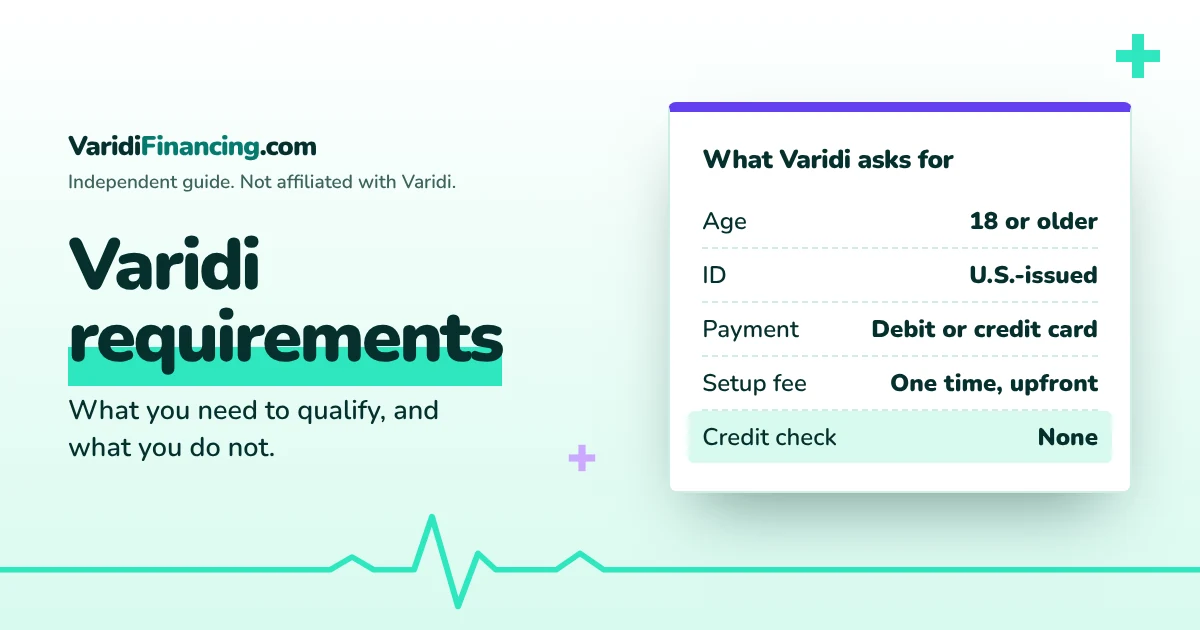
Most financing starts with a credit application. Varidi does not. It asks for a short list of things, and your credit score is not on it. This guide goes through every requirement Varidi publishes, marks the details that come from a study instead of from Varidi, and says plainly where Varidi’s pages are silent.

Varidi requirements, one by one
- A provider that offers VaridiYou cannot apply on your own. You apply through a Varidi-enabled provider, and the plan covers that provider’s bill.[1] Varidi’s website names veterinary clinics as its focus.[4]
- Age 18 or olderVaridi’s eligibility FAQ says you must be at least 18.[1]
- A valid U.S.-issued IDThis is the only document Varidi’s customer page names.[1]
- A debit or credit cardPayments are deducted automatically from the card you designate, on the schedule you agree to at sign-up.[1]
- Basic information about youVaridi says the application needs only basic information and takes a few minutes.[1] It does not list the fields.
- The setup feeVaridi collects a one-time setup fee before the plan starts.[2] Its customer page says the fee depends on the information you self-report.[1]
- A phoneVaridi says clients apply from their phone at checkout, with no app to download.[5]
What Varidi does not require
- No credit check. Varidi says it does not use credit scores, credit reports or credit bureaus.[3]
- No minimum credit score. Eligibility is based on your ability to make the payments, not on your credit history.[1]
- No traditional application. Varidi’s FAQ says it does not rely on a traditional application process.[2]
- No app. There is nothing to download.[5]
Where Varidi’s pages are silent. The customer page does not mention a Social Security number, proof of income or a bank account.[1] That is not a promise that you will never be asked for one. If any of these would be a problem for you, ask the front desk before you start the application.
How the decision is made
Varidi’s own wording is short: eligibility is based on your ability to make the required payments.[1] The clearest description of how that works comes from a 2025 study of Varidi plans at 16 veterinary clinics, published in Frontiers in Veterinary Science. On the guaranteed plan, the monthly payment could not be more than 10% of the applicant’s self-reported income, and plans were covered automatically up to $4,000.[6]
The table applies that rule. For each income, it shows the highest payment and the largest bill that would fit at three plan lengths.
Swipe the table sideways to see every column.
| Monthly income | Highest payment | Largest bill, 6 months | Largest bill, 9 months | Largest bill, 12 months |
|---|---|---|---|---|
| $1,500 | $150 | $900 | $1,350 | $1,800 |
| $2,000 | $200 | $1,200 | $1,800 | $2,400 |
| $3,000 | $300 | $1,800 | $2,700 | $3,600 |
| $4,000 | $400 | $2,400 | $3,600 | $4,000 (study limit) |
| $5,000 | $500 | $3,000 | $4,000 (study limit) | $4,000 (study limit) |
Read it as a guide, not a guarantee. The 10% rule is how the study describes Varidi’s guaranteed plan. Varidi does not publish it as a policy, your provider sets the term,[6] and the income figure is the one you report.
If your payment comes out too high, you have two levers: a longer term, or a smaller first phase of treatment.
The setup fee you need on day one
Being approved is not the last requirement. You also need the setup fee in hand, because Varidi collects it before the plan starts.[2] Varidi says the fee typically runs from 2% to 18% of the plan, depending on your profile and the number of payments.[2] In the 2025 study it was 18% to 22% on guaranteed plans and 5% upfront on true payment plans.[6]
Swipe the table sideways to see every column.
| Amount on the plan | 5% fee | 10% fee | 18% fee | 22% fee |
|---|---|---|---|---|
| $300 bill | $15 | $30 | $54 | $66 |
| $600 bill | $30 | $60 | $108 | $132 |
| $1,200 bill | $60 | $120 | $216 | $264 |
| $2,400 bill | $120 | $240 | $432 | $528 |
If the fee is more than you can cover today, ask whether the provider offers the lower-fee true payment plan, and pay part of the bill now so that less of it goes on the plan. Our article Is Varidi really 0%? explains the fee in full.
A worked example: does this bill qualify?
Say your monthly income is $2,800 and the estimate is $1,500. Here is how the two money requirements play out, using the study’s 10% rule.[6]
- The payment test. Ten percent of $2,800 is $280 a month. Over 6 months, $1,500 works out to $250.00 a month, which fits. Over 9 months it drops to $166.67.
- The setup fee. At 5% you need $75 today. At 10% it is $150, at 18% it is $270 and at 22% it is $330.
- The result. You would need between $75 and $330 on day one, and then $250.00 a month for six months. Your own figures will differ, so ask for both numbers before you agree.
Plan limits: amount and term
- Amount. Varidi does not publish a maximum. In the 2025 study, guaranteed plans were covered automatically up to $4,000, and on true payment plans the clinic set the amount.[6]
- Term. The provider sets it. In the study the minimum was 6 months and the average was 9.[6]
- Typical size. The average plan in the study was $623.77, repaid at $64.74 a month.[6]
How the requirements compare with other payment options
The main thing that sets Varidi apart is what it leaves out. Every other common option looks at your credit in some way.
Swipe the table sideways to see every column.
| Option | What approval is based on | Credit check to apply |
|---|---|---|
| Varidi | Your ability to make the payments[1] | None[3] |
| CareCredit | A credit card application with Synchrony Bank[7] | Credit review as part of the card application |
| Cherry | Your credit. Cherry says it approves up to 90% of applicants.[8] | Soft check only[8] |
| Scratchpay | Your credit profile[9] | Checking eligibility does not affect your score[9] |
| Sunbit | Your credit. Sunbit says approvals start at a 500 credit score.[10] | No hard check to apply[10] |
If your credit is fair or better, it is worth checking one of the soft-check options first, because a true 0% offer with no fee costs less than any setup fee. Our Varidi vs. Scratchpay comparison shows how to weigh a fee against a rate.
How to apply for Varidi
- Ask your provider. Say you would like to pay over time, and ask whether they offer Varidi.
- Apply on your phone. Enter your details, see your exact monthly payment and choose a plan that fits your budget.[5][1]
- Pay the setup fee. Once you are approved and the fee is paid, treatment begins and payments start on the agreed schedule.[3]
Varidi says approval is instant.[5] Our guide to how Varidi works covers the process step by step.
Do not meet the Varidi requirements, or your provider does not offer it? See what a personal loan would cost.
Compare financing optionsIf you do not qualify, what to do
- Your provider does not offer Varidi. Varidi has a refer-a-business form you can use to ask them to sign up.[2] In the meantime, see our comparison of Varidi alternatives.
- The payment is too high for your income. Ask for a longer term, or split the treatment into phases.
- You cannot cover the setup fee. Ask about a lower-fee plan type, or pay part of the bill today.
- You are under 18. Varidi requires applicants to be 18 or older,[1] so the plan has to be in an adult’s name.
- You do not have a U.S.-issued ID. Varidi lists it as a requirement.[1] Ask the provider whether it runs its own in-house plan.
A personal loan is another route when Varidi is not available, because it can be used at any provider. Loans carry interest and depend on your credit. You can request personal loan offers through the form on this site, which is run by a third-party lender network.
A checklist for your appointment
- Your U.S.-issued ID
- The debit or credit card you want payments taken from
- Your monthly income figure
- Enough money for the setup fee. Ask for the amount in dollars.
- Your phone, charged
- The written estimate for the treatment
After you qualify
- You see the exact monthly payment before you agree.[1]
- Payments come out of your card automatically.[1]
- You can pay the plan off early with no penalty.[2]
- You can add services by revising the plan with your provider.[2]
- One Varidi account works with any provider in its network.[2]
- On-time payments are not reported to credit bureaus, so the plan does not build credit.[2]
To manage the plan later, see our Varidi login and payments guide.
Varidi requirements FAQ
Does Varidi require a credit check?
What credit score do you need for Varidi?
None. Varidi says eligibility is based on your ability to make the payments, not on your credit history.[1]
Can I get Varidi with bad credit?
Yes, as long as the payment fits your income and your provider offers Varidi. In a 2025 study of Varidi plans, 39.9% of applicants who gave a reason had been declined or approved for too little by another financing option.[6]
Do you need proof of income for Varidi?
Does Varidi require a Social Security number?
Varidi’s customer page does not mention a Social Security number. The only document it names is a valid U.S.-issued ID.[1] If this matters to you, ask the front desk before you start the application.
How old do you have to be to use Varidi?
At least 18.[1]
More guides
- Is Varidi really 0%? The setup fee, explained with real numbers
- Varidi vs. CareCredit: which is safer for a vet or dental bill?
- How to pay a vet bill you can’t afford: 8 options, ranked by cost and risk
- No-credit-check dental payment plans: how they work and what they cost
- Varidi vs. Scratchpay: which vet payment plan costs less?
- Varidi vs. Cherry vs. Sunbit: which payment plan costs less?
- Missed a Varidi payment? What happens and what to do
- Varidi financing: the complete overview
Sources for this guide (10)
- Varidi, “For Customers”. Accessed November 13, 2026.
- Varidi, “Individual Frequently Asked Questions”. Accessed November 13, 2026.
- Varidi, “Services”. Accessed November 13, 2026.
- Varidi, home page. Accessed November 12, 2026.
- Varidi, “How It Works”. Accessed November 12, 2026.
- Cammisa H.J., Hill S. (2025). “A prospective observational study of how veterinary clinics and their clients utilized a no-credit-check, third-party managed installment financing option to increase access to veterinary care.” Frontiers in Veterinary Science, vol. 12. Accessed November 13, 2026.
- NerdWallet, “CareCredit Rewards Mastercard Review” (June 17, 2026). Accessed November 12, 2026.
- Cherry, “Does Cherry Charge Deferred Interest?”. Accessed November 13, 2026.
- Scratchpay, “How It Works”. Accessed November 12, 2026.
- Sunbit, “Dental Financing”. Accessed November 13, 2026.