Start here
- Tell the clinic now that cost is a problem. The options get better when the team knows.
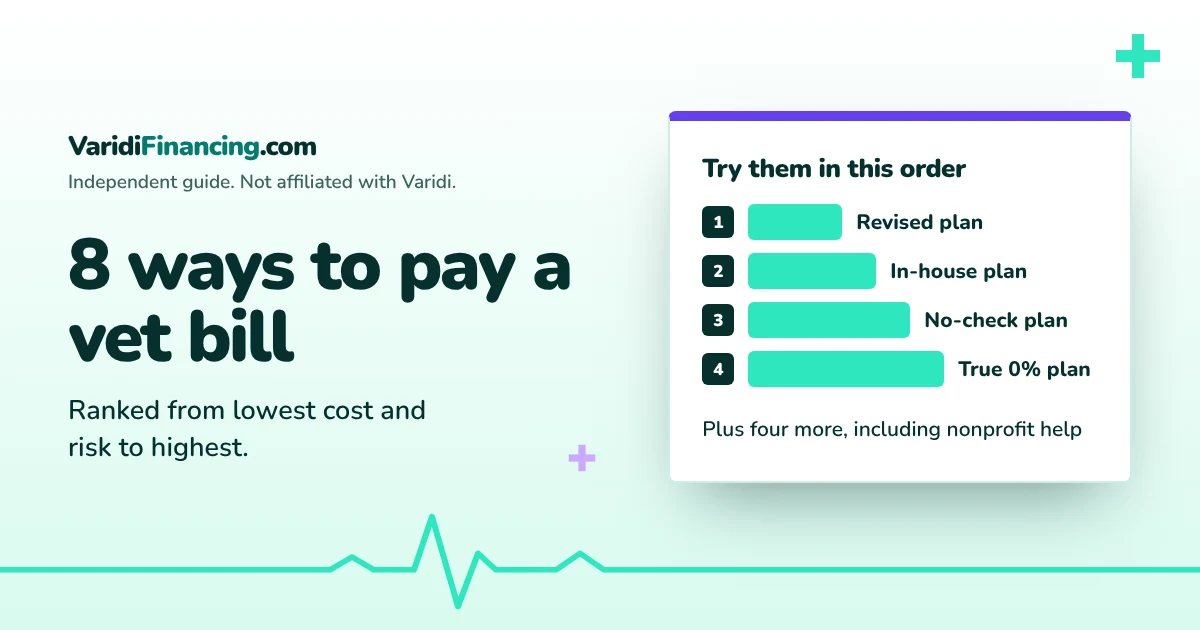
- Work down the list in order. The cheapest fixes come first.
- For any plan, get the total cost in dollars before you agree.
The estimate is on the counter, your pet is in the back and the number is more than you have. You are in common company. More than one in four pet families report being unable to get veterinary care they needed, with money the most common barrier, according to research cited in a 2025 study in Frontiers in Veterinary Science.[1]
That same study measured what is at stake. In 35.8% of cases, clients said that without a payment plan it was very likely they would have surrendered their pet, given it away or chosen euthanasia.[1] So this is worth a few awkward minutes of conversation. Here are eight options, ordered from least to most costly and risky.
1. Ask for a revised treatment plan
Cost: nothing. Risk: low, if the vet agrees the alternative is medically reasonable.
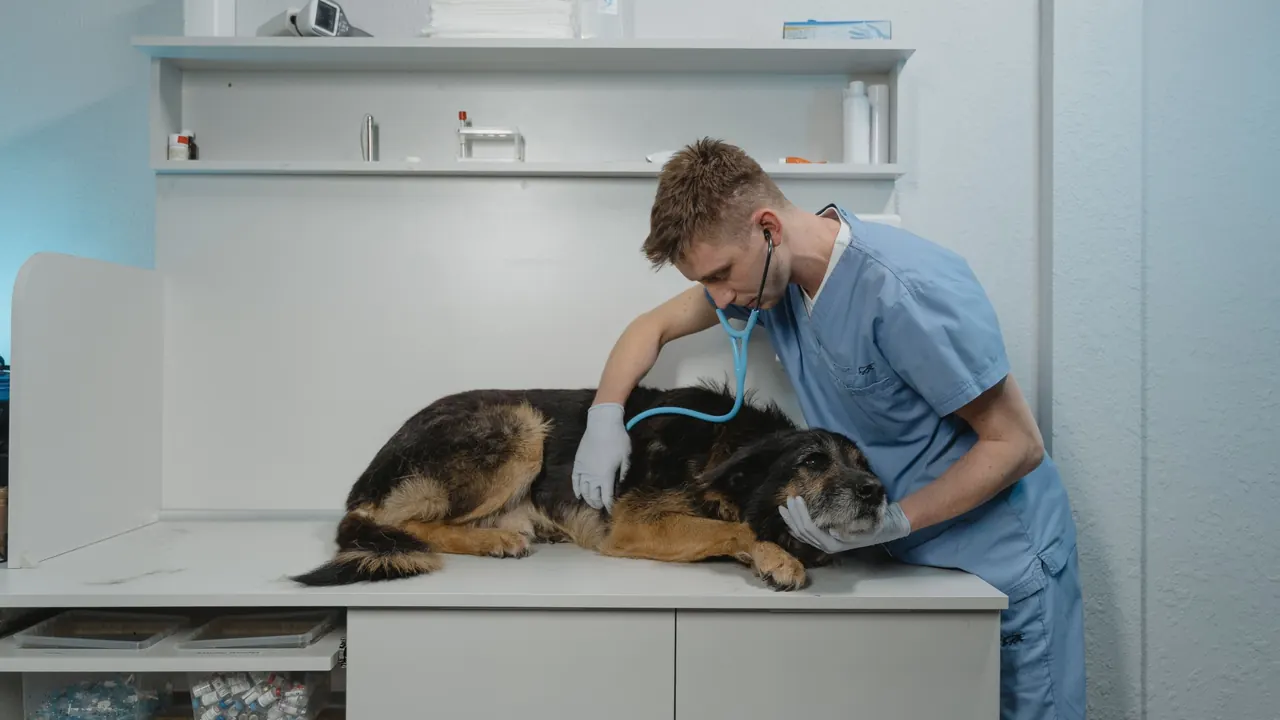
Estimates often describe the most thorough approach. Ask, “What are my options if I can spend half of this?” There may be a staged plan that treats the urgent problem today and the rest later, a different diagnostic route or outpatient care in place of hospitalization. Ask for an itemized estimate so you can see what each line does.
2. Ask about an in-house payment plan
Cost: often low. Risk: low.
Some clinics will split a bill themselves, usually with a deposit and a few monthly payments. They are more likely to say yes to established clients. Ask what the deposit is, whether there is a fee and what happens if a payment is late.
3. A no-credit-check plan such as Varidi
Cost: a one-time fee, no interest. Risk: low and fixed.
Many clinics do not want to carry payment plans on their own books, so they use a third-party service. Varidi is one. It charges no interest, runs no credit check and gives an instant decision at checkout.[2][3] You pay a one-time setup fee before the plan starts, typically 2% to 18% of the amount per Varidi’s FAQ, and 18% to 22% on guaranteed plans in the 2025 study.[4][1]
In that study, 424 accounts financed an average treatment cost of $623.77 at an average of $64.74 a month over 9 months.[1] On a $600 bill with an 18% fee you would pay $108.00 upfront and then $66.67 a month. Read how Varidi works or try the payment estimator.
4. A true 0% point-of-sale plan
Cost: zero to high, depending on your credit. Risk: moderate.
Services such as Cherry, Scratchpay and Sunbit offer installment plans at the clinic. They advertise APRs starting at 0% and rising to about 36%, and they check eligibility without a hard inquiry.[5][6][7] With decent credit you may get a real 0% offer, which beats any fee. With weaker credit you may be quoted a high rate or declined. Check the offer before you commit, since looking is free.
5. A CareCredit promotion, handled carefully
Cost: zero if you clear it on time. Risk: high if you do not.
CareCredit’s 6 to 24 month promotions charge no interest only when the whole balance is paid by the deadline. Miss it and interest is charged back to the purchase date at 32.99% APR.[8] If you use it, divide the bill by one month less than the promotion and automate that payment. Our Varidi vs. CareCredit comparison shows the numbers.
6. A personal loan
Cost: interest for the life of the loan. Risk: moderate.
A personal loan pays out to you, so it works at any clinic, including emergency hospitals that offer no plans. The rate depends on your credit and income. Compare the APR and total repayment, and borrow only what the estimate requires. You can request offers through the form on this site, which is run by a third-party lender network.
7. Nonprofit help and lower-cost care
Cost: reduced or none. Risk: low, but it takes time.
If the situation is not an emergency, call around. Nonprofit clinics, humane societies, veterinary school teaching hospitals and breed or condition-specific assistance funds can reduce the bill or cover part of it. Humane World for Animals maintains a guide to financial help for vet bills and a way to search for clinics by payment options.[9] Funds are limited and often have eligibility rules, so apply to several.
8. Crowdfunding and your own network
Cost: platform fees. Risk: low, but uncertain.
Friends and family are often willing to help with a specific, verifiable vet bill. Share the itemized estimate, set a clear goal and ask the clinic whether donors can pay it directly. This rarely works fast enough for an emergency on its own. It works well alongside a payment plan.
Clinic offers no payment plan at all? A personal loan can be used at any vet.
Compare financing options
If it is an emergency tonight
Emergencies remove the slower options. You cannot wait for a charity application or shop three clinics while your dog is in distress. Focus on what can be decided in the next ten minutes:
- Ask for stabilization first. “What does it cost to stabilize, and what can wait until tomorrow?” often cuts the first bill sharply.
- Ask which payment options the hospital takes. Emergency hospitals commonly work with one or two financing partners. If one is a no-credit-check plan, it will give you a decision on the spot.[2]
- Check a soft-check offer on your phone. Eligibility checks from point-of-sale lenders do not affect your score, so it costs nothing to look.[6][5]
- Call one person. A family member who can put part of the deposit on a card can turn an impossible number into a workable plan.
Then, once your pet is stable, go back to the top of this list for the follow-up care.
How to compare any two offers in a minute
Payment options are described in different units on purpose. One quotes a fee, another an APR, another a monthly payment. Put them in the same unit: total dollars paid, minus the bill.
- Fee-based plan: the extra cost is the fee. An 18% fee on $600 is $108.00.
- Loan or card: multiply the monthly payment by the number of payments and subtract the bill. $600 at 32.99% APR over 9 months is about $76.16 a month, or about $85.45 extra.[8]
- Deferred interest: the extra cost is $0 if you finish on time and the full back-dated interest if you do not. Price it at the bad outcome unless you are certain.
Then ask the second question: how much is due today? A plan with a lower total can still be the wrong one if you cannot cover its upfront amount this week.
What to say at the front desk
You do not need a speech. Try this:
- “I want to go ahead, but I can’t pay this all today. What payment options do you offer?”
- “Is there a plan with no credit check?”
- “What would the fee be in dollars, and what is the monthly payment?”
- “If I pay part now, does that lower the fee?”
Before the next emergency
Once this bill is under control, two habits reduce the odds of facing the same moment again. Set aside a small automatic amount each month in a separate account for pet costs. And price pet insurance or a clinic wellness plan while your pet is healthy, since pre-existing conditions are commonly excluded. Neither helps today. Both help next time.
Frequently asked questions
Can a vet refuse to treat my pet if I can’t pay?
Private veterinary practices generally can require payment or a payment arrangement before non-emergency treatment. Policies vary by clinic and by state. Say early that cost is a concern, because most teams would rather adjust the plan than lose the patient.
Do vets offer payment plans with no credit check?
Some do. Humane World for Animals suggests asking your veterinarian about expanded payment plans, including no-credit-check options such as Varidi or VetBilling.[9] Availability depends on the clinic.
How much does a Varidi vet payment plan cost?
What should I avoid when paying a vet bill?
Be very cautious with payday loans and car title loans, which combine very high costs with short deadlines. Also avoid a deferred-interest promotion unless you are certain you can clear the full balance before it ends.
More guides
- Is Varidi really 0%? The setup fee, explained with real numbers
- Varidi vs. CareCredit: which is safer for a vet or dental bill?
- No-credit-check dental payment plans: how they work and what they cost
- Varidi vs. Scratchpay: which vet payment plan costs less?
- Varidi requirements: who qualifies and what you need to apply
- Varidi vs. Cherry vs. Sunbit: which payment plan costs less?
- Missed a Varidi payment? What happens and what to do
- Varidi financing: the complete overview
Sources (9)
- Cammisa H.J., Hill S. (2025). “A prospective observational study of how veterinary clinics and their clients utilized a no-credit-check, third-party managed installment financing option to increase access to veterinary care.” Frontiers in Veterinary Science, vol. 12. Accessed November 13, 2026.
- Varidi, “How It Works”. Accessed November 12, 2026.
- Varidi, “Services”. Accessed November 13, 2026.
- Varidi, “Individual Frequently Asked Questions”. Accessed November 13, 2026.
- Cherry, “Does Cherry Charge Deferred Interest?”. Accessed November 13, 2026.
- Scratchpay, “How It Works”. Accessed November 12, 2026.
- Sunbit, “Dental Financing”. Accessed November 13, 2026.
- NerdWallet, “CareCredit Rewards Mastercard Review” (June 17, 2026). Accessed November 12, 2026.
- Humane World for Animals, “Help paying vet bills: Payment plans, resources and more”. Accessed November 12, 2026.